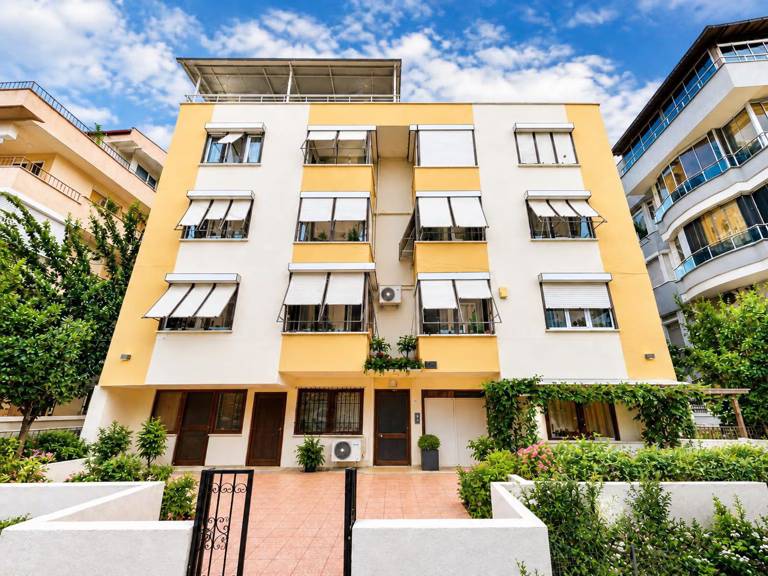
Does the title deed say kat irtifakı or kat mülkiyeti? We explain what each record means, how it relates to the occupancy permit and what to check before buying.
The two terms you meet most often in apartment listings and title deed records are kat irtifakı (condominium easement) and kat mülkiyeti (condominium ownership). Both show that you hold a right over an independent unit in a building, but their legal meaning and practical consequences differ. In this guide we explain both records in plain language, based on Condominium Law No. 634 and Zoning Law No. 3194.
The definitions in the law
Under Article 2 of the Condominium Law, condominium ownership is the right of ownership established over the sections of a main real property that are suitable for separate and independent use (independent units). A condominium easement is an easement right established by the landowners, over the independent units of a building that is to be built or is under construction on a plot, so that those units can later become subject to condominium ownership.
In short, a condominium easement is a kind of “preliminary right” for a building that has not yet been completed, or whose completion has not yet been officially documented. Article 3 of the law says so explicitly: the condominium easement is a type of easement tied to the land share, and it is converted into condominium ownership ex officio on the basis of the building occupancy permit issued for the whole building.
The key to the transition: the occupancy permit (iskân)
The deciding document in moving from a condominium easement to condominium ownership is the building occupancy permit (yapı kullanma izin belgesi), commonly called iskân. Under Article 10 of the Condominium Law, the change of type is made ex officio for buildings that have received an occupancy permit; if the property has already been registered with a condominium easement, it is converted to condominium ownership without requiring any other document. The law also states that these transactions are exempt from the revolving fund service fee.
Article 3 of the law says the conversion can be carried out even at the request of just one of the landowners or condominium easement holders. In other words, all owners in the building do not need to act together.
What can a condominium easement record mean?
A condominium easement record does not by itself mean a “problematic apartment”; it is normal in newly completed buildings while the occupancy process is still under way. However, if a building that has been in use for years is still recorded as a condominium easement, you need to find out why. Possible reasons include:
- The occupancy permit may never have been obtained.
- The building may have been constructed contrary to its permit and annexes.
- The permit may have been obtained but not reflected in the title deed.
Under Article 31 of the Zoning Law, buildings that have not obtained an occupancy permit are not supplied with electricity, water and sewerage services until the permit is obtained, while independent units that have obtained an occupancy permit are supplied. For this reason, the occupancy status matters not only for the title deed record but also for daily use.
Building management during the condominium easement period
Under Article 17 of the law, if a building with an established condominium easement has been physically completed and two thirds of its independent units have actually begun to be used, the provisions on condominium ownership apply to the management of the main real property even if the transition to condominium ownership has not taken place. This allows matters such as maintenance fees (aidat), the election of a manager and the management plan to be handled. Condominium easement holders may also appoint a manager from among themselves or from outside to see the building through to completion.
The land share matters in both cases
Under Article 3 of the law, both condominium ownership and condominium easement are established by showing the land share allocated in the project in proportion to the value of the independent units, calculated according to their location and size. If land shares have not been allocated in proportion to the values of the independent units, each owner may apply to the court to have them readjusted. Because the land share can be decisive in matters such as urban transformation, rebuilding and the sharing of common expenses, it should always be checked in the title deed record.
A small note on tax
The Revenue Administration's 2026 guide states that the registration of real estate obtained as a result of constructing a building on a plot, or of giving the plot in exchange for flats, is treated as a correction of type (cins tashihi), and that the title registration date is accepted as the acquisition date. For those who receive an apartment in exchange for land, this date affects the start of the five-year period for capital gains on value increase.
Checklist when buying an apartment
- See whether the title deed says “condominium easement” or “condominium ownership”.
- If it is a condominium easement, ask the relevant municipality about the occupancy permit status of the building.
- Compare the independent unit number, floor, nature and land share with the project.
- Check whether the annotations section of the title deed contains a record such as a zoning violation.
- Ask for the building management plan and the maintenance fee arrangement.
- Find out how the electricity and water subscriptions are set up for the apartment.
Conclusion
A condominium easement is a record showing that the building's completion and documentation process is not yet finished; condominium ownership shows that the process has been completed with the occupancy permit. Finding out before you buy why the record is in its current state helps you avoid subscription, loan and resale problems later. Aktif Emlak can help you compile the title deed and occupancy information for an apartment you are considering in the Edremit Gulf.